



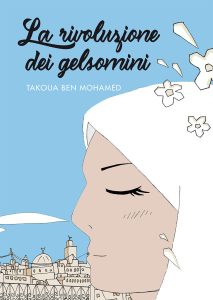
La rivoluzione dei gelsomini
(The jasmine revolution) Book not yet available in English
Summary:
When she was only eight years old, Takoua had to leave the country where she was born to join her father, a political refugee in Italy. It was only much later, after the Jasmine Revolution that overthrew Ben Ali’s dictatorship, that this young woman, who had grown up speaking with a Roman accent, could return to Tunisia to piece together her family history, expose the mechanisms of repression and show how women – the main protagonists of this story – were its victims. By retracing that journey in reverse, which took her from the gates of the Sahara Desert to the outskirts of Rome, we discover Takoua’s story. This is the story of one of the many girls born or raised in Italy by non-Italian parents that many still insist on calling foreigners.
Edited by: Centro MeTRa - Università di Bologna (Italy)
Comment:
“One question has always been on Takoua’s mind: “Who am I?”. Born in Tunisia in 1991, as the sixth child of a family torn apart by the regime’s repression – her father was forced to flee before she was born – she left the country at the age of eight to join her father, a political refugee in Italy. After a lifetime spent in Rome, Takoua finally returns to visit Tunisia, now freed from Ben Ali’s dictatorship thanks to the Jasmine Revolution, to rediscover her roots, reconnect with them, and reclaim them. In this autobiographical graphic novel, Takoua Ben Mohamed questions her identity: “I don’t know if this is an outward or a return journey. I don’t know where my home is. Whether it’s in the deep south of Tunisia, in the Sahara Desert, or among the busy streets of Rome. Some tell me it’s here; others tell me it’s there”. The search for and definition of one’s identity is a common thread running through the whole book. The answers for Takoua, as for many of her peers, children of migrants, are not clear-cut; their identities are fluid and plural. With an internal, intimate and personal perspective, Takoua Ben Mohamed shares her story of searching for, reclaiming and affirming her identity and sense of belonging. The opening pages, which briefly outline the history of Tunisia from its independence in 1956 to the rise of Ben Ali, soon give way to the author’s own story. A story told trying to bring back – and recreate – the light-heartedness of childhood and preserve its purity. The essential lines and sketchy, often caricatural figures convey the spontaneity of feelings that characterises young age. In the intertwining of individual and collective history, the book does not hide the most dramatic events, represented graphically with clear, white letters on a black background. Nor does it ignore the role of women, the main victims of the regime’s repression either because they were political activists or because they were mothers, wives or daughters of activists and opposition members. Women’s resistance is given ample space in the chapter “Movimento delle donne ombra” (Shadow women’s movement) and is epitomised by the protagonist’s mother, but also by her aunt and grandmother. This chapter also serves as an opportunity to explore the status and condition of women in post-independence Tunisia and under the Ben Ali regime. During these years, the promotion of gender equality proclaimed and trumpeted by the political powers went hand in hand with the repression of dissident women, primarily those who chose to wear the veil. The afterwords by Renata Pepicelli, professor of History of Islamic Countries at the University of Pisa, and Leila El Houssi, professor of History of Islamic Countries at the University of Padua, are valuable guides for readers. They help to contextualise the author’s narrative not only from a historical and political point of view but also in the current cultural framework, highlighting the extensive research carried out to tell a complex story in a simple way.”