



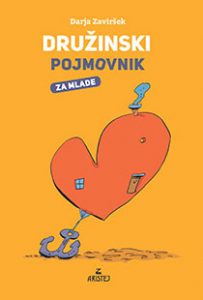
Družinski pojmovnik za mlade
(Young People's Glossary of Family) Book not yet available in English
Summary:
We never really ask ourselves which are the types of human activity that make a family. Different people have different opinions when it comes to that. This is probably the case because there are as many different families as there are people who belong to them. There is the legal definition of a family, but it is very much possible, nowadays, for anyone to decide who they are going to treat as part of their family and why. Some people treat their pets as part of the family, because they take care of them and are attached to them. Some count their coworkers as family, and others their kidney donor without whom they would not be alive anymore. In most cases, people define their family as a group of people that mean a lot to them over an extended period of time, and to which they feel an emotional attachment: “We’re like a family!” It depends on their immediate experience, who children count as family. Some of them believe their family consists of people from only one household, usually “mum, dad and me”. Others include people from multiple households into their definitions of families. Those children’s descriptions can be very broad! “Mum, dad, my little brother, his little brother, grandma and grandpa, my aunt, my other little brother’s mum, Tina, Veronica and our doggy.” (Paragraph taken from the author’s introduction)
Edited by: Mestna knjižnica Ljubljana
Comment:
People have always lived in communities. Even today, one’s family is one of the most important environments for anybody. A family is a private space, but there have also always been external pressures and pragmatic interest from state, religious, and economic institutions trying to influence how families operate. The sociologist Darja Zaviršek presents the multiplicity of families from the past and the present before remarking that while families can offer someone love and support, they may also be places of neglect and cruelty. Nowadays, families are most often built on love and the principle of free choice, much of which can be attributed to women’s liberation. Unfortunately, however, this is not the case everywhere. (source: publisher) The book has received the Golden Pear Mark of Quality. It is targeted at the age range 14+, but it is also suitable for younger readers who are capable of critical independent reading.