



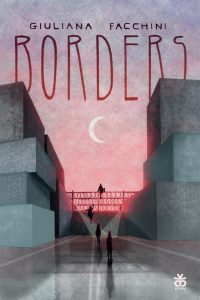
Borders
Book not yet available in English
Summary:
Lindgren, Dickens, Verne, and Alcott are four teenagers. They live in the suburbs of Magnolia, a megalopolis built in the middle of a desert of insulating concrete. Fifty years have passed since the great plague that polluted the planet and created new balances. But the four of them, helped by the old lady Olmo, do not want to get used to the brutality of this new world and decide to set off in search of Brest, a mythical land where it may be possible to start over…
Edited by: Centro MeTRa - Università di Bologna (Italy)
Comment:
The story is set in the near future, in the year 2079, after an epidemic triggered by the environment’s revolt against human exploitation. Those who survived built a technological city, enclosed by high walls and surrounded by a vast concrete desert. In this metropolis, called Magnolia, the past and literature have been erased. Like all dystopian cities, Magnolia is gray, stifling, and rigid: knowledge is controlled, books are forbidden, and where knowledge is lacking, there is no freedom – and no dreams. A woman, Olmo, along with her four adopted children, to whom she has given the names of long-forgotten writers, is the one who upsets this situation. She has taught them to love nature and books, both of which are banned from Magnolia. Encouraged by Olmo to undertake a journey to an island where seeds of plants and flowers have presumably been preserved, the four encounter other ways of living and begin to reflect on the contradictions of the society they come from. But above all, they learn that nothing is as it seems, and that the boundary between good and evil – as often happens in Giuliana Facchini’s books – is blurry, and life is a continuous redefinition of the certainties we believe we have acquired. The novel is, above all, an environmentalist outcry: it speaks of biodiversity, the planet’s fate – topics that are crucial and deeply felt by today’s younger generations. It’s a gripping coming-of-age story, written in a brisk, engaging prose and layered with multiple levels of reading. The novel won the Rodari Prize in 2022, with the following recognition: “For the intelligence and the personal, compelling style with which Giuliana Facchini focuses on a future already present in so many advanced technologies and brings out in her young protagonists that need for autonomy which should belong to every individual. A committed and ‘civil’ novel that does not give in to apocalyptic or moralistic temptations but places freedom at the core