



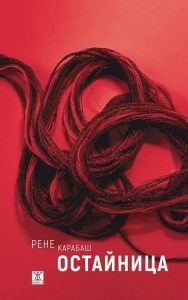
Остайница
(She who remains) Book not yet available in English
Summary:
The novel takes the reader to the harsh Kanun of Leke Dukagini (κanun – a set of customary rules and norms), which still reigns in isolated areas of the Balkans. In it, women become sworn virgins and turn into men by cutting their hair and dressing them in men’s clothes. Blood feuds between families are an everyday occurrence, love is equal to death, and a woman is equal to twenty oxen. Nothing more. Honor is measured by “two fingers above the forehead”. In this patriarchy, death is a constant guest in almost every home. This truth is not foreign, it is our truth. The story of a person and the choices he makes, followed by the irreversible consequences of them. The book introduces us to Bekia, a girl who desperately wants to be the son of her father, who wanted to have a boy. How far can you go to become a son? Is it a sin to run away from death? Is it wrong to indulge in passion at the cost of someone else’s life? This is a story about a man beyond gender, beyond the words “son” and “daughter”, “man” and “woman”, about a man who has gathered the wrath and mercy of God into his 21 grams of soul. /Vladimir Zarev/
Edited by: Regional Public Library "Petko Rachev Slaveikov" (Bulgaria)
Comment:
“She Who Remains is a meditation on womanhood, love, family and honor, written almost entirely in a non-linear stream of consciousness. The primary setting is a remote village in the Albanian mountains still ruled by the Kanun where a woman’s worth is measured in oxen while men settle scores with shotguns. Bekija, whose gender fluidity is rooted deep into her being, is secretly in love with a Bulgarian girl, but is arranged to marry a man. Her only way of escaping the marriage is to take a vow of chastity and become a man in the eyes of the law – a so-called sworn virgin. In a matter of hours, Bekija becomes Matija. However, Bekija isn’t the only person to disappear — her decision to call off the wedding destroys her family. The text is deliberately ambiguous, possessing a fluidity at the line level which underscores the all-at-onceness of Bekija/Matija’s identity. This is a powerful, lyrical work that approaches the concept of gender in visceral, almost primal ways and inevitably discusses the consequences, stemming from deeply-rooted patriarchal traditions.”
– Izidora Angel (Izidora Angel is a Bulgarian-born memoirist, essayist and literary translator based in Chicago.)