



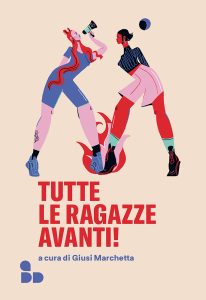
Tutte le ragazze avanti!
(All the girls ahead!) Book not yet available in English
Summary:
“What does it mean to be a feminist in Italy today? Eleven young women writers, journalists, and artists offer their answers: being a warrior and fighter since childhood, like Giulia Gianni; challenging the limits imposed by society in order to be free, like Lucia Brandoli; becoming a woman after growing up in an environment that only sees you as a wife and mother, like Giulia Perona. Feminism is also the way you watch and “read” TV series, as Marina Pierri does, or the perspective with which you navigate the professional life to be independent, as described by Giulia Cavaliere and Claudia Durastanti. The body plays a key role in the fight for women’s rights, as Marta Corato points out; a body that Giulia Blasi invites us to free from moral judgement, while urging every girl to rediscover her right to exist, to be whole. Being a feminist also means believing that things can change, believing in it and being an activist like Maria Marchese or Marzia D’Amico, who points to a world where being a sister means moving forward together, just like Giulia Sagramola. These voices are joined by those of Silvia Grasso, Giada Letonja, Ottavia Madami, Allegra Moreschi, and Elisabetta Rossi. “All girls to the front!” shouted the Bikini Kill frontwoman, Kathleen Hannah, from the stage, inviting girls to move to the front rows. Only then would the band start play. Thus, in a world used to excluding them, she reserved a place in the front row for girls to watch the show, listen to the music, and participate in the concert by singing their anger and the simple joy of being there together. “
Edited by: Centro MeTRa - Università di Bologna (Italy)
Comment:
“Tutte le ragazze avanti (All girls to the front) collects 18 themed essays, plus the editor’s introductory texts, offering reflections from female voices on the experiences, challenges and reality of feminism in contemporary society, particularly in Italy. Starting from a simple question (“What does it mean to be a feminist in Italy today?”), each contribution addresses the discovery of feminism from both a personal and social perspective and deals with different and fundamental issues such as female identity, women’s rights, sexism, the #metoo movement, linguistic sexism and language issues, gender-based violence, the body, the fight for gender equality and against stereotypes, and the importance of education. A previous edition of the book was published in 2018, which inspired the Tavolo delle ragazze (Girls’ Table) project, a series of meetings and discussions on a range of topics, from sexism to human rights, in which a group of girls (and one boy) aged between 15 and 28 took part. Some of their contributions are included in the book. The Tavolo led to a Manifesto dei diritti delle ragazze (Girls’ Rights Manifesto), illustrated by the independent collective Tutte Collective, and to the creation of the podcast Tutte le ragazze avanti (All girls to the front). Based on the podcast, the book’s final section includes reflections on abortion, fat-shaming, school and education, and climate change. The book was conceived as an open letter to anyone interested in gender equality, human rights, the world of work and relationships. The first-person narratives, Marchetta’s use of the informal “you” to address readers directly, and the constant invitations from the various female voices challenge readers to answer those same questions, to take action, to discover, and to add their own voices to those in the book. By exposing the stereotypes and constraints imposed by patriarchal society, as well as the limitations on the freedoms that girls and women have experienced and continue to experience, the contributions show that some progress has been made, but there is still a long way to go. And the road ahead is still long. Calling for reflection and action, the book urges us to celebrate and defend the rights and freedoms we have gained, but also to commit ourselves and fight every day, in our everyday lives, for a fairer and more inclusive society, for those rights and freedoms that we still do not have. Tutte le ragazze avanti is not simply an exploration of feminism – or rather, feminisms – it is also an appeal, a call to action and change.”