



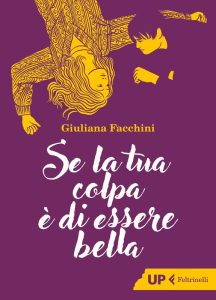
Se la tua colpa è di essere bella
(If your fault is being beautiful) Book not yet available in English
Summary:
Valerio is almost seventeen and attends high school. He lives with his single mother and has a peaceful relationship with her, but he has a crush on the thirty-five-year-old woman that lives in his building, Elena. He dedicates anonymous love poems to her, which he secretly slips under her door. Carlos, Valerio’s high school classmate and closest friend, also lives in the former concierge’s apartment of the building. Last but not least there is Lavinia, the inseparable companion of the two boys, who always wears a flower in her hair. Life flows peacefully for the three teenagers, divided between study, leisure, and reflections on their adolescent problems, until certain events burst into their lives and change them forever. The most beautiful girl in high school is attacked in a nightclub during a birthday party. Carmen, Carlos’ little sister, is hit by a car while chasing a ball she found in the park and is taken to the hospital for tests. Life has never seemed so fragile. Elena, the attractive neighbor, is also being treated in the same place, and Valerio now sees her in a different light.
Edited by: Centro MeTRa - Università di Bologna (Italy)
Comment:
“Se la tua colpa è di essere bella” is a novel that clearly demonstrates the writing skills of the excellent Giuliana Facchini and appears tailor-made to raise important and urgent questions, doubts, and debates. In just a few pages (145), the writer covers a lot of different topics, succeeding in the difficult task of addressing sensitive issues without trivializing or weighing them down by adopting an educational or moralizing approach. The novel deals with gender-based violence (a girl sexually assaulted in a nightclub), aesthetic ideals, illness, and families (fortunately plural, in their imperfect and human diversity). It also covers first loves, friendship, and politics. All these themes are filtered through the point of view of the narrator, Valerio, a 16-year-old boy who is neither a prodigy nor a genius at school, much less someone particularly involved in political and social issues. In short, he is a boy like many others: he asks himself a thousand questions and doubts, he wonders how to behave and what to think about the events that happen. Thanks to all those characteristics, he is immediately likeable and captivating, not least because he almost always demonstrates intelligence and sensitivity. Perhaps, the most interesting part of the novel is the story of Laura Sagassi, the most beautiful girl in the school. She is sexually assaulted in a nightclub and rescued just in time by a classmate. Subsequently, she becomes the target of a social media storm of ‘victim blaming’. This is followed by many debates at school, which are very well described and lead to a solidarity initiative in support of their classmate. In short, after showing their hesitations and doubts, Giuliana Facchini chooses to place her trust in the young people. Their ultimate representation carries a positive response and this can also be intended as an invitation and a sign of hope. It is a pity that the victim of violence is given almost no voice, as she deserved more space and, above all, more words coming from her own mouth. On the other hand, the male protagonist’s perspective has the additional value of showing the boys’ point of view and their doubts, which is also important and often overlooked when addressing the issue of gender-based violence.