



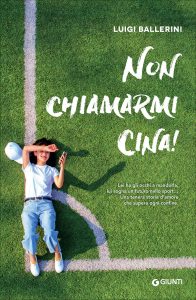
Non chiamarmi Cina!
(Do not call me China!) Book not yet available in English
Summary:
Antonio, aka Toto, attends the fourth year of high school and has a secret dream that he entrusts only to the copybook he has recently started writing: to become a professional footballer. He is a boy like many others: some close friends, a caring family, and a strict coach. But someone is about to make him discover new things about himself and the world. It’s Rossana, a girl who lives in Milan and has Chinese origins. A strong girl, able to take on responsibilities which most of Toto’s mates have no idea about. Always dealing with the difficulties of living between two cultures, without feeling comfortable in either one or the other, Rossana goes straight ahead, in search of a new solution that belongs to her alone. The love that develops between the two teenagers, narrated in the first person by Toto, becomes an adventure in which their young lives, full of dreams, contrasts, and difficulties, intersect with the difficult path that our society is called to take in order to become a welcoming place for everyone. [Publisher’s website]
Edited by: Centro MeTRa - Università di Bologna (Italy)
Comment:
Written in the form of a diary, this novel tells the love story of two teenagers. A difficult, tormented story, in which cultural diversity fascinates and makes people fall in love and at the same time divides them. Antonio, aka Toto, is very passionate about football, but also about writing, and is a very sensitive boy. He falls in love with Rossana, but born in Italy, in Milan, from a Chinese family. The young couple gets to know and likes each other, but Rossana immediately makes it clear that her Chinese origins will be a problem in their relationship. The young woman does not hesitate to denounce the parochialism of the Milanese Chinese community, which means that her family would never agree to a relationship with an Italian boy. It is Rossana’s difficult life and diversity, which make her so special compared to her peers, that fascinate Antonio. From the young girl’s stories, which we hear through Antonio’s admiring voice, we discover that Rossana is very good at school, but has to study at night, because during the day she works in Chinatown, in the bar owned by her family. The work is hard, as the young woman often has to manage the business on her own, and she has to deal with the advances of the patrons. Yet Rossana, who hates being called “China” by those who don’t know her, is not discouraged, and lives like an equilibrist straddling two cultures, two worlds. Antonio’s love, however, breaks this fragile equilibrium, because he tries to go beyond the ethnic difference to free Rossana from the cage imposed on her by her family and community. An ethnicity that becomes a crystal prison, erasing Rossana’s identity as well as her feelings and enclosing her in a melting pot of stereotyped representations, to which the girl rebels with her decisive “Don’t call me China.” The love of the two young people, threatened by Antonio’s imminent move to Zurich, where he will be hired by the city’s football team, seems destined to fade away. But Antonio’s father advises him not to give up: if his love is true, he will find a way to find new life. Shortly before his departure, Rossana agrees to see Antonio one last time, and gives him a lucky bamboo plant. A little plant that becomes the symbol of a love that will perhaps survive the flow of time, distance and, above all, modern forms of communitarianism. A plant that comes out of a “clash of civilisations” to become the symbol of a hope and a passion that can rewrite the history of these modern-day Romeo and Juliet. The overcoming of stereotypes, and the real openness and acceptance of the Other, will perhaps then be the possibility of reinventing the bitter ending of Shakespeare’s tragedy.