



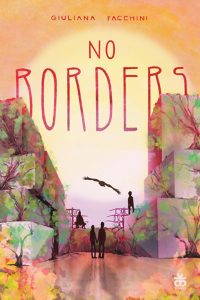
No borders
Book not yet available in English
Summary:
How does the adventurous saga of the Alcott, Dickens, Verne, and Lindgren siblings continue? In Borders, the four of them fled the city of Magnolia in search of nature (and seeds), but now, after a long journey, they return with the idea of starting a revolution and fixing the world. But this is not an easy job, and everything always turns out to be two-faced. Every action requires choices, things that can be gained or given up forever. Being alone or being together.
Edited by: Centro MeTRa - Università di Bologna (Italy)
Comment:
No Borders tells the long-awaited return journey announced in the previous novel, Borders (winner of the 2022 Rodari Prize). While Borders narrated the escape from Magnolia and the discovery of a possible elsewhere, here the adventure continues with the protagonists’ return to the city they had fled. They come back changed, more mature, and above all ready to act and change things. Set against the backdrop of a powerful ecopolitical allegory, Giuliana Facchini weaves a wide-ranging narrative that blends technological dystopia with the fundamental questions of the coming-of-age novel. The teens have seen other worlds: they have found a seed vault, symbolizing renewal, and encountered communities that live in ways completely opposite to Magnolia. These people, though lacking in science and technology, struggle to preserve the past – books, memory – and to reconnect with a simpler way of life, in harmony with nature. The novel asks what true progress is: is it the hyper-advanced megacity, where everything is controlled, and disease has been eradicated – but where freedom is abolished? Or is it a more precarious existence, but a free one, where a balance between nature and culture is still possible? The utopian answer is neither nostalgic nor regressive: No Borders imagines a future where technology and nature can coexist, where progress does not mean domination, and where poetry – understood as a creative, imaginative, transformative force – can once again become central to humanity. As in the first volume, the fifty chapters alternate the voices of the protagonists, exploring their thoughts, choices, and emotions. Friendships and emotional bonds become increasingly important: they are the driving force of change, the foundation for a new ethics of responsibility. But the novel also strongly engages with questions of gender. This is embodied in the story of a young girl from a “primitive” village where women are forced to bear children to ensure the survival of the species, who chooses instead to stay in Magnolia. There, in the much-criticized megacity, she glimpses for the first time the possibility of self-determination, a place where women