



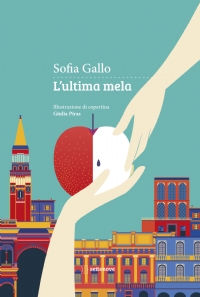
L’ultima mela
(The last apple) Book not yet available in English
Summary:
” The news of an unpunished assault on an underage girl prompts Alice, a student at Parini High School in Milan, to investigate in search of the culprits. In the background, there is the beginning of a modern-day romance and the reconstruction of the protagonist’s complex family history. The latter is intertwined with the women’s movements of the 1960s and 1970s and the scandal of the historic survey “What girls think” (“Cosa pensano le ragazze”), published fifty years earlier in her high school’s student newspaper “La zanzara”. This investigation becomes a journey of personal growth, in which Alice discovers new feelings, unravels the mysteries surrounding her past, and becomes an active part of the women’s movement against violence. She will discover that prejudices are bad advisers and violence can come from anywhere. It is an evil beast that must always be fought, both inside and outside ourselves. “
Edited by: Centro MeTRa - Università di Bologna (Italy)
Comment:
” “L’ultima mela” is presented as a thriller/noir aimed at a teenage audience aged 14 and over (information available on the author’s website, but not included in the paratextual elements: https://sofiagallo.it/lultima-mela/). The plot revolves around Alice, a 15-year-old trapped in a web of dysfunctional relationships: family, friends, and love interests. She decides to investigate the case of Sabrina, a girl her age who is a victim of physical violence and hospitalized in critical condition. Alice’s investigation becomes the driving force behind a dual quest: the truth about the case and a journey of self-exploration that leads her to a confrontation with her own experiences and various oppressive structures. The novel is structured in micro-chapters with a theatrical layout: ‘First Act’, ‘Second Act’, ‘Intermission’. Each one focuses on the main characters of the chapter that are made explicit by the title itself. This choice aids readability and guides young readers in mapping the characters, while also creating a very dynamic narrative rhythm. However, although the narrative idea is potentially effective and the plot stimulates attention, “L’ultima mela” presents several critical issues, both in terms of narrative coherence and with the representation of gender-based violence. The construction of the characters, especially the male ones, appears discontinuous and lacking in depth: figures who appear and disappear without a coherent narrative logic. For example, Alice’s father or her long-term boyfriend, who perform stereotypical and poorly developed actions. Some characters’ past, such as Aunt Griselda, is introduced but not developed, contributing to narrative gaps. How the author chooses to handle Sabrina’s story is even more problematic. The poisoning by apples carried out by the same nurse that beat up Sabrina is the noir element of the book. Although it is obviously symbolically connoted (a reference to fairy tales, female guilt, original sin), it ends up being not very credible and poorly justified in the realistic frame of the narrative (context: Milan in the 2000s). The depiction of the investigation is sometimes far-fetched, in fact, Alice and Armando, the friend who has always had feelings for her and follows her in uncovering the story, move around the hospital with extreme freedom. However, this could make us reflect on the need for a solid community in order to address patriarchal violence. In fact, Alice relies on the student community for the first time, discovers, so to speak, what it means to be a feminist and organizes a march in honor of Sabrina. The motive for the crime was the alleged betrayal of the victim, Sabrina, and initially the culprit was identified as her father. The novel presents various problems, since the author’s attempt to address patriarchal violence as a systemic and structural phenomenon emerges strongly but this intention remains partly unfulfilled. Violence is represented in a stereotypical way as an expression of often uncontrolled male anger, but without an adequate contextualization. Heterosexual relationships, the only relational model represented, are imbued with dysfunctional dynamics, abandonment, and control. Alice’s boyfriend Federico abandons her and disappears, her mother is marked by a difficult past linked to her early years spent in prison due to her mother’s militancy in the 1960s and embodies an unemotional parental figure who is unable to manage her anger towards her ex-husband. Moreover, her aunt Griselda attempts to take on the mediator task, making up for the lack of communication with the other adults, but her role remains unclear. None of the characters take responsibility or make an effort to ‘break out’ of the imposed limits. On the other hand, the main theme of the novel, violence, is presented to us in many ways: men who beat women, absent husbands and the protests of 1968 that re-emerge reading the Parini High School’s newspaper “La Zanzara”. The issue is that they are not handled seriously, the reader understands that Alice is a victim and she is going through something horrible. A proof is Alice’s attempt to escape, her spending a night away from home and knowing that her relationship with her mother is dysfunctional because it is based on a lack of communication. However, the author gives no further explanation as to why and violence is stereotyped as an excess of anger, mainly from men. The risk of this representation is thinking that it is young women who should find a solution. Armando’s character is relevant and his presence takes on an ambiguous connotation. Initially, he is motivated by the desire to ‘be close’ to the protagonist, for whom he has a soft spot but with an insistence that borders on pressure. He appears to be driven by a male desire for possession, disguised as alliance. Alice notices this behaviour and both make a few jokes about his attentions towards her: is this an attempt to trivialize the insistent calls for attention from a boy who feels rejected? Only at a later stage the character does develop his own autonomy in the narrative, but the risk is that young readers will legitimize, rather than question, pressure and abuse of power as ‘normal’ relational strategies. When Alice manages to organize a march for Sabrina in the final scene, it is supposed to represent an emancipatory turning point for the protagonist. However, the event is problematized by the use of slogans that are now outdated for a feminist point of view. A banner reads ‘Where is the monster?’ (p. 190), reviving the rhetoric of the ‘monster’ which, as is well known, isolates violent episodes rather than recognising its systemic nature. In the last chapter of the novel, Alice makes peace with the parental and emotional figures in her life: she finds a balance between her father, his new family, her mother Eleonora, she refuses to read the letter that her ex-boyfriend Federico wrote to her before disappearing, which his brother has delivered to her and she finally gives in to Armando’s interest. These episodes can convey an ambiguous message despite the protagonist’s journey of growth and awareness. The idea that a male figure must necessarily accompany and support her on her path to truth and justice ultimately weakens the initial message. The only time that Alice seems to act by herself, she is taken home by an adult, the father of Sabrina’s hospital roommate and this can be read as a further sign of this narrative dependence on male authority. To sum up, “L’ultima mela” tackles crucial and sensitive issues, using a narrative lens that is not sufficiently effective. While there is a clear intention of introducing teenage readers to a reflection on patriarchal violence, on sisterhood as a form of resistance and more, the representation remains anchored to stereotypical dynamics. The risk is the transmission of misleading models to anyone who has not already developed, on their own or through other readings, sharper reflections on gender-based violence, regardless of age. “