



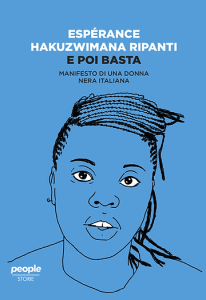
E poi basta – Manifesto di una donna nera italiana
(And then enough is enough - A black Italian woman's manifesto) Book not yet available in English
Summary:
After a lifetime spent answering questions and satisfying the curiosity of others about her origins, her skin, and her opinions, Espérance Hakuzwimana Ripanti uses writing as a tool to reclaim her space and expose herself, revealing herself—in her own way, on her own terms, and on her own conditions. “E poi basta, is the story of how I left my room, making everything I found in books and over the years a reality. A call from the hero to which I answered in my own way, without ever forgetting my story, which began in Rwanda, and the limitations I encountered on the streets of Italy. The story of my life, which I just wanted to read, and of a summer that changed my life instead.” But it is also the story of her traveling companions, the experiences that marked her the most, the protagonists who shared the front line with her. An essay, a biography, a ballad, a manifesto: the story of her struggle against prejudice, and finally the search for solutions, between darkness and sunlight.
Edited by: Centro MeTRa - Università di Bologna (Italy)
Comment:
” “E poi basta. Manifesto di una donna nera italiana” is a book that is difficult to define: a hybrid text, consisting of the author’s memories, reflections, and emotions related to her experience of racism as a black Italian woman. An urgent and intense read, “E poi basta” challenges its audience, calling for acute and honest reflection on the power relations and prejudices that operate in today’s Italian society, and on our complicity in these systems. Drawing on her own background, the author outlines a vision of the tensions, microaggressions, aggression, and violence that have unfortunately characterized her experience—but also that of many other people—in present day Italy. A key aspect of the book is the protagonist’s embodied and physical experience of racism and discrimination: the looks, the physical contact (wanted and unwanted), and the sexualization are all elements that affect her experience. The narrator’s strength and intelligence, and her ability to transform the corrosive, everyday violence she observes and experiences into a political agenda—and to articulate, through all this, a sense of agency, identity, and strength—are, in themselves, one of the many reasons why this book is essential reading. For Hakuzwimana, writing becomes a tool for reclaiming her identity, in all its uniqueness and complexity. Precisely because of the sensitivity of the topics covered and the direct, sincere, sometimes almost raw writing style used to narrate episodes of physical, emotional, and psychological violence, “E poi basta” is not an easy read, especially for young adults. It is a book that requires a certain intellectual and emotional maturity on the part of its audience, but which remains, for all the reasons mentioned, not only a recommended but also an essential reading for anyone growing up in Italy these days. “