



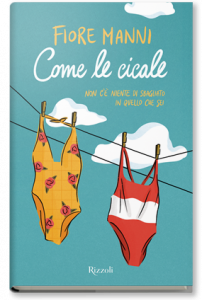
Come le cicale
(Like cicadas) Book not yet available in English
Summary:
The first year of secondary school is over, yet Teresa still feels like a child, with her hair constantly messed up and her knees constantly skinned. It is as if she has fallen behind. And when she arrives at the beach house where she spends her holidays every year, she discovers to her astonishment and sadness that there too she is destined to feel like the out-of-place, inadequate one: her lifelong playmates are now only interested in nail polish and boys, her relationship with her best friend is now suddenly complicated, and everyone seems to have grown up except her. Where is the sparkling Terry, the confident, mature version of herself she’s been waiting for?, she asks herself every day as she looks in the mirror. But just when Teresa has already resigned herself to a terrible summer, Agata appears. Sweet and strong at the same time, sincere, kind and beautiful, she immediately wins Teresa’s attention and affection. And much more: she makes her heart beat faster, her hands sweat, and makes her dream of her first kiss… [Publisher’s website]
Edited by: Centro MeTRa - Università di Bologna (Italy)
Comment:
This short novel by Fiore Manni is a rare example in the Italian publishing context, for its ability to tell, with simple but precise words, a path of personal growth and evolution, which also includes the discovery and acceptance of one’s sexuality. During the summer holidays the protagonist, Terry, falls in love with a girl of her age, Agata, and it is the evolution of her relationship with the girl, but also with her friends, that marks the passage from childhood to adolescence. Terry’s feelings and emotions for her friend are told by the author with rare naturalness, in a delicate and respectful way. The story unfolds without any particular drama, with the protagonist surrounded by well-portrayed and generally positive secondary characters, including her parents, who – for once in a novel dedicated to this audience – are empathetic and supportive. The novel ends with an open epilogue, and thus departs from the gloomy tones and the tendency to show homosexuality in a problematic way that is typical of (too) many Italian books. In short, Come le cicale is a truly beautiful story, compelling and at the same time profound, whose reading is recommended for everyone.