



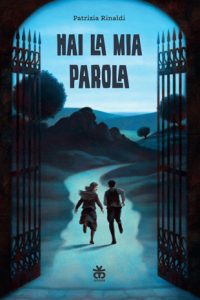
Hai la mia parola
(You have my word) Book not yet available in English
Summary:
Nera and Mariagabriela are sisters. One is beautiful, gorgeous. The other is called the cripple. One is sweet and meek, the other is a rebel and has a way with words. Together they stand up to abuse and harassment. But after the viscount pays heavy attentions to Mariagabriela, everything goes wrong: the girl vanishes into thin air and Nera runs away, together with her loyal friend Michelino. And so begins an adventure involving secret prisons and despicable nobles, deceptions and disguises, injustices and the desire to set the world right, with sword and words.
In a distant and fairy-tale time, on a rocky and wild island, a story of love and cruelty, of words and courage. [Publisher’s website]
Edited by: Centro MeTRa - Università di Bologna (Italy)
Comment:
Hai la mia parola is a coming-of-age novel that revisits and combines the fairytale tradition and the historical novel to give us a story of rebellion and resilience, a story of liberation, in which strong and determined female characters take centre stage. Action and adventure punctuate the chapters, where the search for her missing sister takes on the tone of a detective story. The issues dealt with in this medieval fairy tale set in an archaic and rural Sardinia are still topical. If Mariagabriela embodies the girl, the woman who refuses to be submissive and abused and to be treated like an object, Nera represents diversity and the power to break free from social constraints. Her physical disability makes her ‘different’ and earns her the derogatory nickname ‘the cripple’ by which the community labels her. But it is precisely because of this diversity that, in a world of illiterates, she has learned to read and write and knows how to use words. And thanks to words she will be able to face the challenges and overcome the difficulties along the way, redeeming herself in the eyes of all. In her adventure, the fearless heroine can rely on the loyal Michelino, who knows how to love beyond appearences, and the nun Ganar Asuncion de Mendoza y Manrique de Luna, another strong, resourceful, and independent female character, a symbol of wisdom. As the title suggests, the novel is a hymn to the power of words (it is no coincidence that the chapters of the three parts are marked by the letters of the alphabet), but also to the value of diversities and the infinite possibilities that open up before us when we manage to free ourselves from the gaze of others and truly be ourselves.