



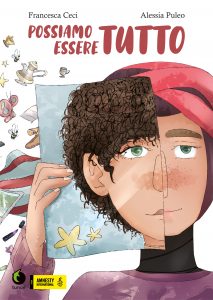
Possiamo essere tutto
(We can be anything) Book not yet available in English
Summary:
Raja is 22 years old and dreams of opening her own bookshop. Amal is 17, has decided to wear a veil, and loves theatre and modern art. Hadi is 11 years old and he still does not know that being born in a country is not enough to be its citizen.
Together with their parents, who moved to Rome from Morocco fifteen years earlier, they live in between their two cultures, trying to balance their Moroccan heritage and their Italian upbringing. They are caught between their family religion and the freedom to choose, between what society expects of them and what they feel they are. They experience a split yet multiple identity. [Back cover]
Edited by: Centro MeTRa - Università di Bologna (Italy)
Comment:
“Possiamo essere tutto (We can be anything) deals with inclusion, stereotypes, and prejudices, through the moving story of the Fares, an Islamic family of Moroccan heritage composed of Salim, the father, Nur, the mother, Raja and Amal, the daughters, and Hadi, the youngest son. Influenced by the rules and the way of life of their new country, Raja, Amal, and Raji experience their relationship with Islam differently, as is often the case in many Muslim families. For Raja, Islam belongs to her family background and her personal sphere, Amal embraced it as she was growing up and made it central to her life by choosing to wear a veil, while Hadi is the only one born in Rome.
The two sisters could not be more different, caught between their religion, the wish to simply be themselves, and the desire to finally be able to live in Italy without feeling constantly being judged by society. But being judged is inevitable when you belong to those Italians who are often referred to as the ‘second generation,’ i.e. the children of men and women who left their home country in search of work or fleeing war, famine, environmental crises, political and religious persecution. This ‘second generation’ has come to represent the new face of Italy and 4.2% of the population (2.5 million people).
Raja dreams of opening her own bookshop, where she can sell books written by strong, independent, empowered women as she’d like to be. Amal simply wants to live her life as a teenager without feeling judged all the time for wearing a veil; she wants to enjoy her love story with the boy she likes without having to feel ashamed and wishing to hide from the comments of his parents, worried that dating an Islamic girl could make their son’s life more complicated. And then there is Hadi, who wonders why his classmates think that Islamic women are submissive just because they wear the veil, that religious, identity, and political symbol embodying one of the many facets of their identity. But if for Islamic girls the veil is an important symbol of who they are, of their being, it often happens that they are not understood, or rather, that they are discriminated against by society and become targets of the increasing Islamophobia that is sweeping across Italy and Europe. As readers, we too have to face a narrow-minded world, which tends to set strict limits and boundaries and forces a mother to take off her veil because she allegedly shoplifted, or hinders a girl’s internship based on too usual and too common stereotypes.
Raja and Amal’s different paths challenge many of the stereotypes about Islam and Muslim women, who are generally considered submissive and depicted through stereotyped representations. The two sisters, who differ in their personalities and choices, are independent and resourceful girls who exemplify the plurality of women’s experiences within Islam, while also showing that Islam is not a new and foreign religion in Italy, but is becoming an ever more integral part of it.” [Publisher’s website]
The book has been published in collaboration with Amnesty International and includes contributions by Renata Pepicelli, Professor of Islamic Studies and History of Islamic Countries (University of Pisa), and Francesca Cesarotti, Director of the Education and Training Office of Amnesty International Italy, with a closing text by the writer Fatima Bouhtouch. These texts, together with the final bibliography and sitography, are very useful resources to contextualise and further discuss discrimination and integration issues covered by the graphic novel. In a balanced, unbiased, and empathic way, the book attempts to explore these themes and to suggest possible approaches: listening, respect, acceptance of otherness and diversities, because difference is an asset. Gender issues then intersect with multiculturalism, integration and the construction of one’s own identity, a key moment in the life of any teenager and young person, and all the more so for those who live in between two worlds and two cultures. As Amal’s words remind us, “None of us is a unitary entity, neither of thoughts, nor of feelings, nor of ideas. Two halves are not enough to represent me, I am not just white or just black, grey is not enough either. My identity is a puzzle of fragments that never fit together on their own, but which I am learning to put together.”