



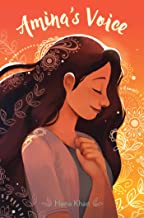
Amina’s Voice
Summary:
Amina is a young Pakistani-American girl starting middle school, struggling with all the changes in her life: at school, with her friends, at home, and in the Muslim community she is a part of. She loves to sing and is a brilliant singer, encouraged by her best friend Soojin and her family, but she is terrified in front of audiences. Lately, Soojin has been changing: she wants to change her name to an ‘American’ one and has become friends with the girl who used to bully both her and Amina. Things are changing for Amina at home too, when their uncle from Pakistan comes to stay and upsets the family dynamic with his conservative ideals, suggesting Amina’s interest in music, singing, and playing the piano is forbidden in Islam. There is so much change in Amina’s life, but we see her find her own voice and her place in the world.
Edited by: Dublin City University
Comment:
This book is about a young girl’s coming to terms with her identity, religion, and culture in the context of contemporary US society, one often fraught with discrimination and racism for Pakistani Muslims. In addition to all the challenges of early teenage years for girls, Amina struggles with Soojin’s relinquishing of her Korean cultural identity, which makes Amina feel displaced within their friendship and with the things that mark Amina out as ‘different’ too. The novel balances Amina’s experiences of adults’ perceptions of her gender: though her conservative uncle remarks on the unsuitability of her interest in music, her parents emphasise there is nothing wrong with this. Amina herself actively questions her uncle’s position when he deems it appropriate that her older brother can play basketball but music is bad. She admires and respects her friend Dahlia who wears the hijab everywhere with a natural confidence, though she cannot imagine doing this herself. Amina is not immune to comments on her body by others, demonstrated by a boy in her class commenting on the hair on her legs at a very young age. The book’s treatment of her older brother Mustafa is also interesting and the Islamic Centre is presented as a place of positive support and male role models. Amina’s finding of her own voice is tied to her culture and religion, as comparisons are made between the Arabic language, music, and community. and the American one.