



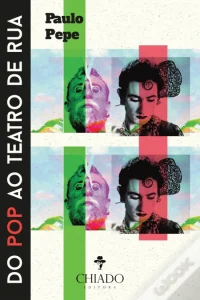
Do Pop ao Teatro de Rua Revoluções Ibéricas de Género em António Variações e José Pérez Ocaña
(From Pop to Street Theatre: Iberian Gender Revolutions in António Variações and José Pérez Ocaña) Book not yet available in English
Summary:
“In an era in which some changes are beginning to take place with regard to homosexuality, Iberia still has a long way to go to break with the mentalities of male domination. Over the centuries, the institutions of power have persisted in governing our bodies, and have legislated against gender, sexuality and sexual acts considered to be deviant from the prescribed norms. Music, dance and performance have also been judged for the ambiguities they could perpetuate. In the Iberian context, these identities have also not been exempt from these laws and punishments, and with the establishment of the Salazar regime in Portugal and the Franco regime in Spain, these laws and coercive measures against sexual acts that deviate from the norm were reinforced. With the end of these dictatorial regimes in the 1970s, Iberia experienced a boom in various socio-cultural and political aspects. It was during this same time that Portugal and Spain came to know two performers who marked this period of transition: António Variações and José Pérez Ocaña. These two artists would not only end up changing the reality of these two societies, but would also end up playing a pivotal role in sexual and gender terms, although this was not visible to everyone. Both artists ended up playing an extremely important role in articulating and constructing identities outside the normative sphere.”
Edited by: Biblioteca Lúcio Craveiro da Silva
Comment:
“My research focuses on the musical productions and performances of António Variações in Portugal and José Pérez Ocaña in Spain. First, I will develop a critical analysis of sexuality, gender, and the binary constructions of masculinity and femininity. I will explore how same-sex sexual acts began to be legislated and medicalized by Western societies and in what ways (homo)sexuality was succumbed to the bas-fonds by dictatorial regimes. In this study I will offer a careful reading of the cultural creations of Variações and Ocaña. To support the textual, musical and visual analysis of the selected cultural representations, queer theory will be adopted as a theoretical model. The main concepts postulated and established by Michel Foucault, Judith Butler, Eve Kosofsky Sedgwick, among others, will be applied to cultural productions to allow a queer deconstruction of texts, performances and relationships with the historical, social and cultural context of Portugal and Spain. In addition to this general objective, the main objective of this research is to demonstrate the importance that António Variações and José Perez Ocaña had in the construction of a queer culture in these countries, since both countries had been “dominated” for decades by the dictatorial regimes of Salazar and Franco. These regimes defended the idea that homosexuality was a “perversion” and as such, it would have to be exterminated, so as not to jeopardize the good values and morality of these nations. Therefore, the main objective of this thesis will be the analysis of the performances of these artists in counterpoint to the dominant representations of gender established by these two dictatorial regimes and the reasons that led these artists to use music and performances to express non-normative gender and sexual identities. By analyzing these periods, we can observe the reasons why queer culture was non-existent, or more problematically, invisible.”