



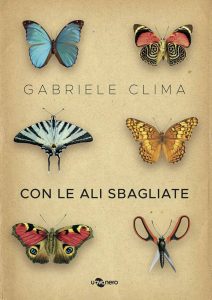
Con le ali sbagliate
(With the wrong wings) Book not yet available in English
Summary:
“Nino, seventeen years old, few friends, only child, shyly discovers love. One above all: Tiziano. Nino has always known he was gay, but his parents (an obsessive mother and a father who is overly confident in the absoluteness of his values) are convinced that it is something wrong, unnatural. Something to be cured. For this reason, Nino finds himself in the religious community run by Don Claudio, a sort of “clinic” where girls and boys like him go to “heal” and rediscover their true nature, the one desired by God. When the situation becomes unbearable, the only solution is to escape. Thus begins a series of encounters, both dangerous and salvific, that Nino will have in search of himself, so that he can finally present himself to the world as “Nino, male, homosexual.” Gabriele Clima, winner of an Andersen Award, presents us with a raw, uncompromising novel that tackles a topic still too often considered taboo. And he does so thanks to a captivating writing, full of rhythm and poetry. “
Edited by: Centro MeTRa - Università di Bologna (Italy)
Comment:
Gabriele Clima’s novel is a courageous book within the Italian publishing scene, published by Uovonero after being rejected by other publishing houses and inspired by a true story. Courageous in questioning two realities that are still considered untouchable in Italy: family and religion. Although the author does not question them in an absolute sense, he strongly denounces, through the voice and gaze of the protagonist, Nino’s family and a priest, Don Claudio, who runs a ‘spiritual residence’ whose purpose is to ‘cure’ homosexuality. The novel thus echoes two splendid and freshly published books: “The Miseducation of Cameron Post” by Emily M. Danforth and “Boy Erased” by Garrard Conley, addressing the issue of so-called ‘reparative therapies’, which are banned in several countries around the world and are not discussed enough in Italy. In the first part of the novel, the psychological suffering endured by Nino and the other girls and boys staying at what is also referred to as a “clinic” is described with painful effectiveness. It perfectly depicts the terrible violence of telling a person that their nature is “wrong” in the eyes of God, but that it is possible to be redeemed and return to the right path. This violence is even more ferocious and inhuman when one considers that it is not possible to change a person’s sexual orientation. In the novel, its dramatic and, in some cases, fatal consequences are also well represented. The second part of the book is also effective in recounting Nino’s journey to find himself, understand who he is, comprehend who he can truly trust and will be able to support and accept him. This is a necessity that is distressing in itself but is often reserved for minorities of all kinds. The book shows undeniable qualities and an interest in careful and sensitive writing, which compels the reader to continue reading to find out what will become of Nino. Although, beyond the novel’s excellent intentions, there is sometimes a certain distance between the writer and the themes dealt with. This distance can be felt, for example, in the language: the word ‘homosexual’ is used many times in the novel, which tends to be frowned upon by the LGBTQ+ community because it carries a heavy and difficult history, and in real life it would probably be avoided in favor of the term ‘gay’ (or ‘lesbian’ in the case of girls). The same applies to Grace, a (beautiful) trans character, defined as “transsexual” in the novel, whose life seems almost fatally doomed to a difficult and thankless destiny, which fortunately is not always true for trans people. The metaphor of “wrong wings” also raises some concerns when used in the choice of title, because it emphasizes the lack and the defect (a socially perceived one, not intrinsic to people) rather than more positive aspects. On the other hand, that does not happen when it emerges in the course of the story because there it is clear that the author does not agree with it. That said, the last scene of the book, in which Grace and the protagonist’s father meet, is described by Nino’s voice with such lucid and powerful words that it alone makes the novel worth reading.