



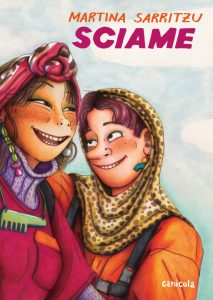
Sciame
(Swarm) Book not yet available in English
Summary:
“Appetito”, “Elettrica”, “Io”, “Abbraccio”, “No”, “Metamorfosi” are the titles of the six stories that make up “Sciame.” After the choral experience of “a.m.a.r.e.”, Martina returns to the heart of adolescence and talks about changing bodies, absolute friendships, confusion, and daily struggles through short stories with a bittersweet flavor.
Edited by: Centro MeTRa - Università di Bologna (Italy)
Comment:
““Sciame” is a collective comic book created within Freewear Academy, a training course promoted by baumhaus, a cooperative based in Bologna. The project brings together six short stories, all focusing on adolescents grappling with everyday experiences, narrated through a sharp and deeply situated lens. Through irony and the right amount of care, the book deals with very sensitive issues, such as the exploration of sexual orientation, the physical and relational discomfort typical of puberty, bullying, dysfunctional relationships, problematic relationships with parents, first experiences with sex, and difficult first choices, such as which university to attend. The stories, which are very short (four to ten pages at most), open in medias res, without preamble, and catapult the reader into fragments of the protagonists’ everyday lives. The visual device reinforces this ‘experiential’ dimension. Thanks to lucidity and realism, the comic is able to transport the reader into the various stories that populate it, stories that could be those of any reader grappling with adolescent issues. The theme of sexual orientation is carefully articulated, reflecting the emotional and social complexity of the queer experience in adolescence. The representation of family relationships is equally significant, particularly the maternal relationship, which does not merely highlight misunderstanding and rejection, but emphasizes the relational need for recognition. Bullying is another theme that is addressed without moralizing, but focusing on the figure of the adolescent as a subject in formation, capable of retroactively questioning their choices. For example, the guilt for being mean to a classmate is described not as a failure, but as an awakening of consciousness. “We stood there without saying a word until the adult disco closed. Even though we had fought so hard to get in, we didn’t care anymore.” In my opinion, the strength of comics lies in their ability to represent adolescent vulnerabilities through storytelling and illustrations that can offer comfort and validation to those going through that age. The title itself refers to the collective dimension of the experience: the group, the community, and alliances as a space for reworking trauma, for reflection, in which to experiment with self-determination. Adolescence is thus portrayed with all its transformative potential, with extreme awareness, focusing on the right to be fragile and flawed, in the process of becoming (‘Metamorphosis’ is, in fact, one of the titles of the stories), and also with the right dose of transformative ‘violence’. “