



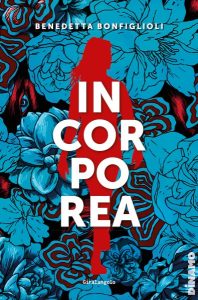
Incorporea
(Incorporeal) Book not yet available in English
Summary:
“Jude would like to become invisible and it’s not that difficult: you just need a method. Her friend Jenny showed her how during the worst summer of her life, when depression took her father away. Jenny is beautiful, independent, bold, and a ball of muscles. She teaches her friend to count calories and she always extends their daily run on the beach by a few minutes. To keep up with her, Jude cuts out her favourite foods from her diet because she can’t handle the joy of eating them. She ends up depriving herself of basically everything, to the point where she no longer “feels” anything. On the brink of disaster, Jude’s mother and grandmother take her to a facility specialized in eating disorders. Here she finds help in the stories of Meri, Michelle, and Nausicaa, who are just like her: they are trying to climb out of that abyss. Then, there is a mysterious musician who plays “Hey Jude” on his trumpet from the house next door… “
Edited by: Centro MeTRa - Università di Bologna (Italy)
Comment:
““Incorporea”, by Benedetta Bonfiglioli, is a young adult novel that focuses on eating disorders. In a broader sense, it also highlights the more general issue of accepting our body as a reflection of accepting the world. Thanks to Jude’s autodiegetic narrative voice, readers enter her complex adolescent world, traumatically marked by the abandonment of her father. In fact, he commits suicide, leaving a trio of female figures (his daughter Jude, his wife, and her maternal grandmother) without any possible answers to such a desperate and aggressive act. The narrative does not adopt a linear style, but confuses the temporal planes, alternating between Jude’s present, which can be perceived from the first pages as a time of ‘repair’, the protagonist’s childhood past, her teenage past of anorexia shared with her friend Jenny, and, finally, her therapeutic past at Casa Domani. This represents a place of ‘exile’, where her mother and grandmother force the protagonist to enter after Jenny’s death. Under the protective guidance of Dr. P. and the handyman Nani in Casa Domani, Jude slowly manages to regain a space of well-being and, above all, of connection with her own body, with many steps forward and equally profound regressions. The residents at Casa Domani try, not always successfully, to escape the prison of eating disorders, some real cages that affect with relentless rhythms the daily lives of those who suffer from them. They are almost exclusively female, with the exception of Nico, a boy who commits self-harm and is seeking a way out of the loneliness and perceived rejection by his family of origin. Especially in the early days, Jude is torn between the desire to empathically connect with the girls that are going through the same therapeutic journey as her and an absolute vocation for isolation. He finds comfort in a mysterious tune with an unknown source that regularly punctuates her walks in nature. Only towards the end of the novel, the protagonist, and consequently the reader, discovers that there is Nico behind the creation of this mysterious music. He is guided by the intention of healing Jude and himself at the same time, using beauty: “The cuts on his arms tormented me as if they were on my own, I felt them throbbing under my skin, with a sharp and persistent pain, as if it could be the same pain that melted away in his music and, gently, knew how to heal mine?” A beauty that will prompt Jude to choose, through painting, a means of expression and a personal language to heal her wounds and give refuge to her thirsty and intelligent soul. The novel ends where it all began: on the opening day of Jude’s solo painting exhibition. The ending does not give in to false optimism but recognizes that “there are no incurable diseases, because whatever the disease is, its depth of pain, the harshness of tomorrow, it is always possible to look after those who are suffering.” Although it does not directly address gender issues, the novel reflects deeply on the body as a mirror of ancestral emotions, which often have their roots in childhood, education, and traumas. All those feelings can find, rather than healing, a sense of “repair,” as Jude understands one day: “My mother touched my head and face and hands, and I felt no discomfort, no pain, but relief. To me, it felt like having a body finally made sense in that touch. Love does have a body, I knew it that day in my mother’s arms.” “