



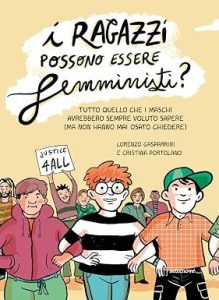
I ragazzi possono essere femministi?
(Can boys be feminist?) Book not yet available in English
Summary:
Who needs feminism? How can I let a girl know I’m interested in her without being creepy? Do I have to be an ally? Can’t we say anything anymore? Starting with these and other questions, the book is aimed at young men, not in the universal masculine sense of “girls and boys” but in the literal sense: young men who want to learn about feminism! To understand a little more and become allies in the struggles of their girl friends and partners. Above all, to free themselves from the stereotypes that still exist about the idea of “man” or “male” and understand how non-toxic masculinity can also do them a lot of good. The book answers the multiple questions that the author has been asked over the years by young people, as a philosopher, feminist activist, educator, and parent of teenage boys. It is written in simple and engaging language, enriched by cartoons and comics by Cristina Portolano, a cartoonist for the magazine Internazionale KIDS. It explains how feminism is not a dangerous ideology “against men” but a liberating force against patriarchal oppression that affects both women and men through social pressures that suffocates individual personality. After many books on self-determination for girls, here is a necessary book so that the boys of today, and the men of tomorrow, can participate in social change as allies and protagonists, deciding critically and autonomously how to become boys and men (Amazon).
Edited by: Centro MeTRa - Università di Bologna (Italy)
Comment:
A series of short question-and-answer texts, in which the reader can clearly observe various ways in which (even) boys can be feminists, answering many possible doubts. The question posed in the title is answered positively, of course, even if the target audience, as indicated by the cover blurb, appears to be composed of people already convinced of the necessity and goodness of feminism. In addition, the author of the text often alludes to a specific age group of readers (“at your age,” “you’re already grown up”), which is not indicated in the book’s cover text. A nice attempt to speak directly to an audience of young people (presumably teenage boys), but the risk of encountering resistance from those who have not already questioned the patriarchal status quo still exists.