



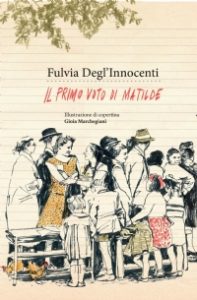
Il primo voto di Matilde
(Matilde's first vote) Book not yet available in English
Summary:
1945. In the Tuscan countryside, the war has just ended. Memories of bombs and hunger are still alive, but there is also a strong desire to start again. Matilde is twenty years old and has stopped her studies early, but her will to grow has not faded. She wants to learn, understand, and discuss the most important issues: politics, the universal suffrage, women’s freedom, the right to contribute together, men and women, to the rebirth of the country. When women are finally called upon to vote for the first time in 1946, the streets are filled with enthusiasm, and they celebrate the first universal suffrage. Everyone flocks from town and country to the polls, but Matilde can only be happy and wait. Only a few more months and she will come of age and be able to go to the polling station at the most solemn moment: the 2nd of June 1946, that is, the Italian referendum to choose between the Monarchy and the Republic. Then, finally, also she will be able to cast her vote. [Publisher’s website]
Edited by: Centro MeTRa - Università di Bologna (Italy)
Comment:
“This gentle story, with drawings by Gioia Marchegiani, aims at informing the younger generations about a crucial moment in our [Italian] democracy. Through the protagonist, it sketches the portrait of a woman who is able to choose independently her future and the society in which she wants to live.” [Original Italian text by Tiziana Bartolini, on Noidonne]
“A story that captures a precise moment in Italian history from the perspective of those who have never been able to express their voices in an official and acknowledged way. These are not famous women or intellectuals. Matilde, her sister Luciana, her mother, her grandmother, and other acquaintances in the village are part of the multitude of women from all social classes and with all levels of education who, for the first time, cast their vote on their own. Some of them decided to confirm an idea that was already clear, some began to break away from the patriarchal models imposed on them, while others followed the instructions they had received. But all of them, without exception, participated in the event with a sense of great happiness, as if it were a party to which they were invited for the first time.” [Original Italian text by Francesca Fradelloni, on Globalist]