



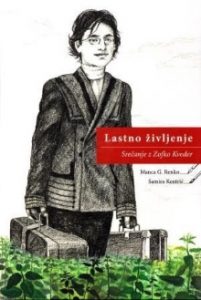
Lastno življenje: srečanje z Zofko Kveder
(A Life of One's Own: An Encounter with Zofka Kveder) Book not yet available in English
Summary:
Slovenian writer Zofka Kveder’s biography A Life of One’s Own is a testament to the fact that historic personalities’ ideas, positions, and struggles never die – they remain alive to this day. The author of the biography, Manca G. Renko, describes the historical place and time of women between late 19th and early 20th centuries, with Zofka Kveder in focus as she personifies women’s struggle for equality and their entry into art and the public life. The book does not shy away from her intimacies either. It is well suited to a young readership thanks to its endless actualizations and a colloquial tone, both of which aid in dialogue building and contemplation. It is also an attempt to fill in the gap at least partially in Slovenian educational system (as well as the Slovenian literary canon), which often renders women invisible or at the very least relegates them to the margins. For this reason, neither primary nor secondary education familiarises its pupils with women artists. The illustrator Samira Kentrić’s illustrations upgrade and complement the message present in the text of A Life of One’s Own. (source: publisher)
Edited by: Mestna knjižnica Ljubljana
Comment:
The book offers an insight into the life of one of the first Slovenian female writers, Zofka Kveder. It presents her childhood and growing up, but the focus is on her adult life. Even as a young girl, Zofka disliked playing with dolls and preferred climbing trees with the neighbour’s two sons. It was already at the time that she did not understand why the boys were praised for this while she was punished. Her view of life was thus earmarked from the onset for endless struggles for gender equality, but also a more just world for everybody. In the world belonging to men, it was an unwelcome struggle, but one which has brought about much of what contemporary women take for granted. The book is targeted at the age range 14+, but it is also suitable for younger readers who are capable of critical independent reading.